
Blog Posts
… What are Transmitters, Receivers & Antennas on Two-Way Radios? … over …
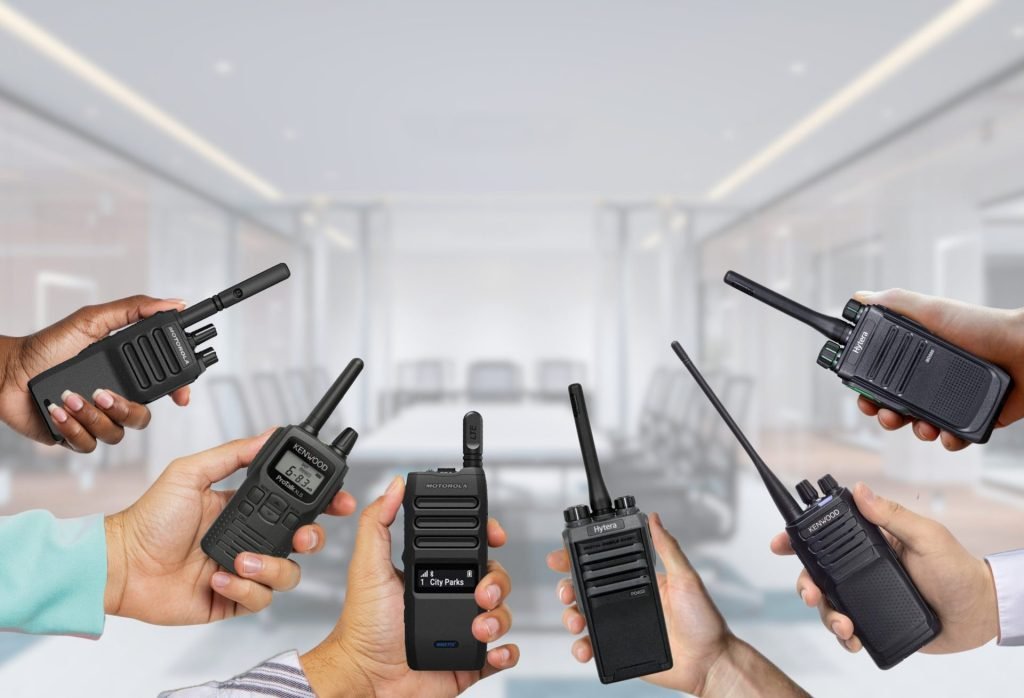
How do you define what a transmitter does compared to what a receiver does? Let’s examine this a little bit closer as we explore what each function really does…
Two-Way Radio Transmitter:
- The transmitter generates a radio signal or wave.
- Key components include:
- Oscillator: Creates the carrier frequency.
- Frequency Multipliers: Boost the frequency to the final output.
- Power Amplifiers: Amplify the signal to reach the antenna.
- The output frequency is called the carrier, which can change based on amplitude or phase modulation.
- Amplitude Modulation (AM) and Frequency Modulation (FM) have distinct characteristics, with FM being less susceptible to interference from RF noise.
Two-Way Radio Receiver:
- The receiver complements the transmitter.
- Its tasks involve:
- Receiving the modulated carrier.
- Processing the signal.
- Sending it to a detector station.
- Stripping off the modulation to restore original information.
- Most radio systems operate with AM or FM.
- A microphone inputs information, and a loudspeaker outputs the received signal.
- Signals are typically analog, but some systems use binary signals (e.g., frequency shift keying) for data transmission.
Digital Signals and Morse Code:
- Digital signals pose challenges for human interpretation due to our analog world.
- Morse Code, based on ones and zeros, is an exception.
- When using digital radio, a digital-to-analog converter is essential for human communication.
Squelch Circuits in Receivers:
- Receivers often feature squelch circuits:
- Turn off output when no signal is detected to prevent continuous noise.
- Allow properly coded signals to pass through.
- Common schemes include CDCSS (continuous digital-coded squelch system) and CTCSS (continuous tone-coded squelch system).
Two-Way Radio Antennas:
- Antennas play a crucial role:
- Transmit the radio signal into space.
- Enable the receiver to pick up energy.
- Lower frequency channels require larger antennas for better communication.
- Antenna height significantly impacts overall coverage.
- Dipole antennas (wire or rigid metal rods) have lengths based on half the wavelength of the carrier frequency.
- Antennas can be vertically or horizontally polarized; most mobile systems use vertical polarization.
In summary, the transmitter, receiver, and antenna together create an effective two-way radio communication system. 📻🔊🌐
